Wednesday, May 28, 2014

Harry Shipman


             Harry Shipman is a contemporary astronomer who is currently still teaching the science at a university level as a professor. Outside of his passions for teaching both astronomy and physics, Shipman is not very well known. He has published an array of books and articles with the aid of other astronomers and researchers during his career thus far. Before residing at the University of Delaware as a professor of astronomy, Shipman attended both Harvard and Caltech, two extremely prestigious schools, where he obtained his degree and became very adept in his field. As an astronomer, Shipman paid little attention to the viewpoints of others when it came to groundbreaking and controversial issues for his time. When he wrote the majority of his papers and his best selling novel, the ideas regarding Black Holes, Quasars and multiple universes were all very taboo in the world of astronomy. Shipman's work played a vital role in the adoption of new and ever changing values in the scientific world with respect to these ideologies. Today he continues to teach at the University of Denver.

"Harry Shipman's Home Page." Welcome to the University of Delaware. N.p., n.d. Web. 28 May 2014.

"Harry L. Shipman." Faculty Board Biographies. N.p., n.d. Web. 28 May 2014.

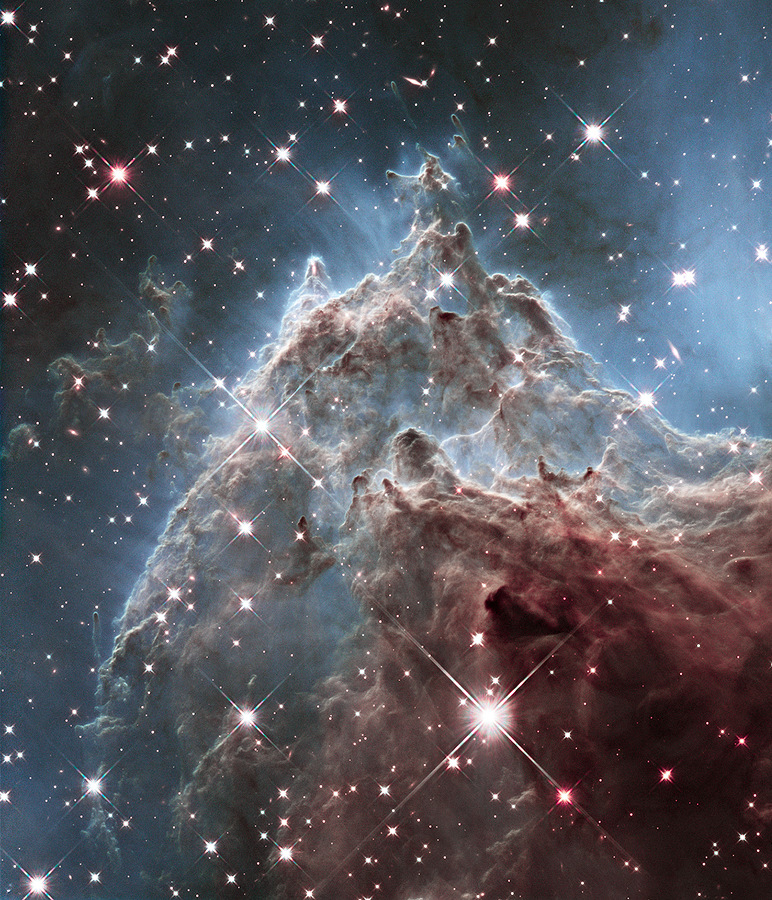
Massive Star Forming Region

See Explanation.  Clicking on the picture will download
 the highest resolution version available.

This is a massive star forming region located roughly 6,400 light years away and near the extremely dense region surrounding the constellation Orion. Star forming regions develop in areas where there is a great amount of material, heat, and matter being pushed together by gravitational forces. The entire region spans about 6 light years of space. These images were originally found by the Hubble Telescope.  

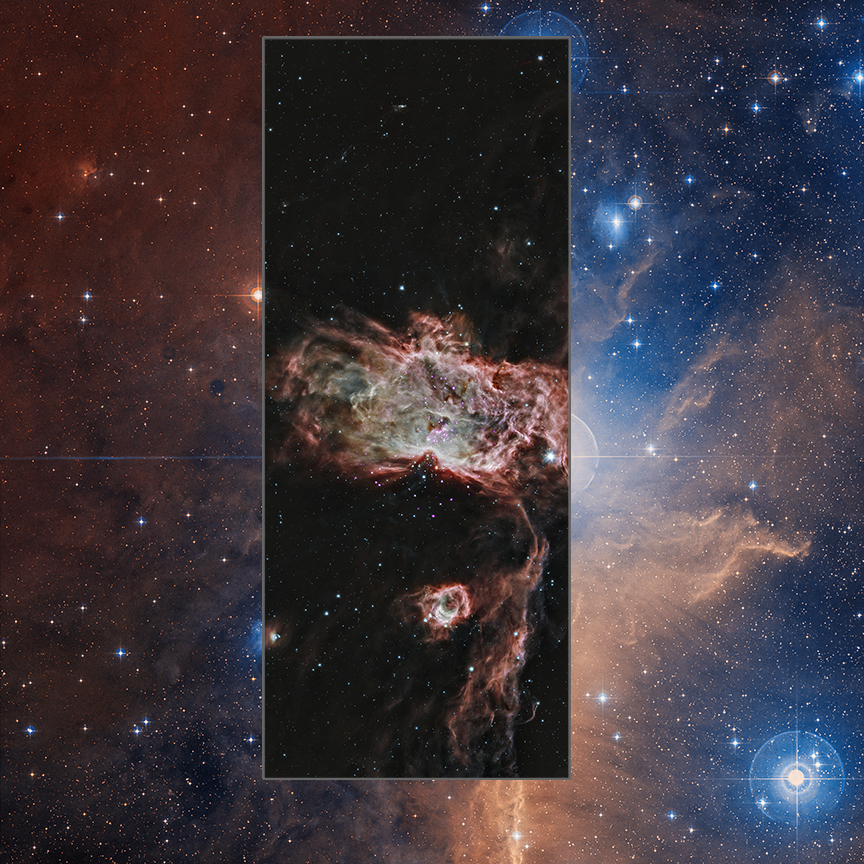
Flame Nebula

See Explanation.
Moving the cursor over the image will bring up an alternate version.
Clicking on the image will bring up the highest resolution version
available.
The Flame Nebula, located a close 1,400 light years away, although riddled with dust and debris, we are still able to peak inside the nebula near Orion's Belt and see new stars forming. Through the use of the Spitzer Space Telescope, we are able to glean so much more valuable knowledge regarding how stars form and the lives of stars themselves. 


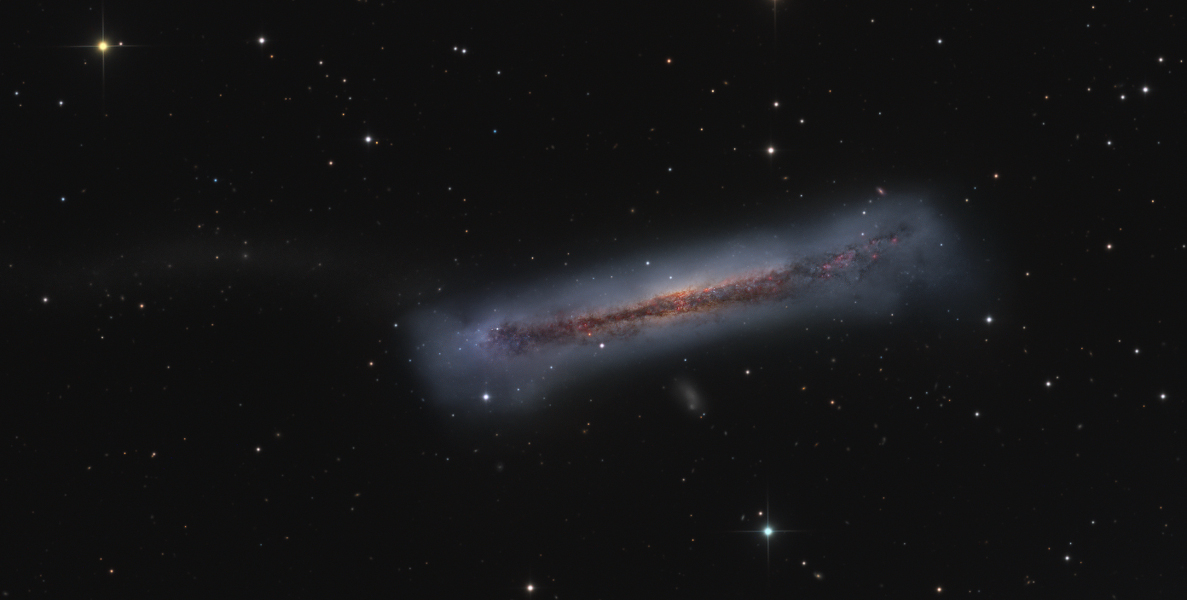
The Hamburger Galaxy

See Explanation.  Clicking on the picture will download
 the highest resolution version available.

These telescopic views give us a view of a far away puffy galaxy surrounded by a disk of dust. Commonly known as the Hamburger Galaxy for its enveloped appearance, this small, spiral galaxy serves as a brilliant example of a "faint but extensive tidal tail". Spanning 100,000 light years across and neighboring two M objects to form the Leo Triplet, the Hamburger Galaxy serves not only as a great example of tidal tail as a result of the gravitational pull between neighboring universes but also as one of out many identifiers in our night sky.  

Monday, March 24, 2014

Biography Resources: Karl Schwarzchild

"Schwarzschild's Spacetime:Introducing the Black Hole." The Light Cone:
The Schwarzschild Black Hole. N.p., n.d. Web. 15 Jan. 2014. http://www.phy.syr.edu/courses/modules/LIGHTCONE/schwarzschild.html.


Sunday, March 16, 2014

The Antennae Galaxies in Collision


Located in the Constellation Corvus, The Crow, are two galaxies colliding. When two galaxies collide, their central stars seldom take part in the destruction. The reason behind this is that galaxies are comprised of a vast amount of space, mostly containing gas and dust. The churning up of the gases between the two galaxies will inevitably spark the birth of millions of stars. 

Wednesday, March 12, 2014

Biography: Karl Schwarzchild

Life

Karl Schwarzchild grew up in a well off home in Frankfurt, Germany. Brought up in a Jewish home in early 20th century, Schwarzchild attended primary school until the age of eleven and had a father who was very active in the community. After primary school, Schwarzchild studied at two universities. One at Strasbourg and another at Munich. He developed a keen aptitude in physics and astronomy. At the age of twenty three he obtained a doctorate and began working at the Kuffner Observatory as an assistant in 1897.

Starting in 1901, Schwarzchild was a professor at the institute of Gottingen. He quickly rose from this position and became the director of the Gottingen Observatory in 1909. This led to a job as the director of the Astrophysical Observatory in Potsdam.

During the heat of World War I in 1914, Schwarzchild developed a skin disease that made him extremely ill. Regardless of the struggle this presented for him, Schwarzchild was still able to produce three papers. Two of the papers were on the theory of relativity and the third was regarding quantum theory. These papers showed explicit solutions to the Einstein field equations. It was the work on these three papers which yeilded what is not commonly known as the "Schwarzchild metric".

Work and Legacy

Black Holes: Schwarzchild predicted that the spacetime of a black hole is curved in a way that caused the future light cones to tip inward. This was shown vividly through the image below.


Event Horizon: From the discovery of light curves came the discovery of event horizons in black holes. What the event horizon does is show a distinguished line between where light can and cannot escape from a black hole as a cause of the light curve and gravitational pull of the mass itself.

Einstein's Theory of Relativity: Applied successfully to Schwarzchild's predictions.  

Tuesday, March 4, 2014

Prominence

This prominence from the sun was captured last week. Prominences can last roughly one month and also have the potential to spark a Coronal Mass Ejection which would push hot gas into the solar system and cause auroras to be visible from Earth.

Sunday, March 2, 2014

Star Gaze at Pine View School, Service Road


March 1st marked the date of yet another Star Gaze on the Pine View Campus. Mr. Chap Percival and Steven Dacey led the Gaze by setting up telescopes for the student to use in order to view an array of space objects up close. During the star gaze we pointed out constellations that we went over in class during the preceding few weeks. We also were shown Canopus, one of the brighter stars in the night sky that is shown in a constellation which we have yet to go over in class, Carina, The Keel. Mr. Percival used his laser pointer to help guide the other students and myself through the constellations by using a process called "star hopping". Other astronomical objects viewed included two emission nebulae and Jupiter through the smaller telescope. In the telescope with Jupiter, four moons were visible at the start of the night. Later on, Mr. Percival changed this view to show a binary star system.

Friday, February 21, 2014

The Long Jet of the Lighthouse Nebula


The Lighthouse Nebula was formed by the wind of a pulsar, a rapidly notating neutron star that rotates at speeds faster than 1,000 km/sec. Located roughly 23,000 light years away towards Carina the Keel near Canopus and Eta Carinae, the image of the wind nebula are clearly shown on the lower right hand side of the X-ray image taken from the Chandra Xray Observatory.

Thursday, February 13, 2014

Messier 63: The Sunflower Galaxy


Messier 63 is about 25 million light-years distant in the constellation Canes Venatici. Also cataloged as NGC 5055, the island universe is nearly 100,000 light-years across. Roughly the same size as the Milky Way Galaxy. Known as The Sunflower Galaxy, M63 sports a bright yellowish core. Its has expansive blue spiral arms and pink star forming regions. A dominant member of a known galaxy group, M63 has faint, extended features that could be the result of gravitational interactions with nearby galaxies. 

Friday, January 24, 2014

Double Cluster in Perseus

Depicted in the lower center of the photo are two double clusters which are seen spanning roughtly 3.5 degrees across the constellation Perseus. The names of these clusters are h and Chi Persei. The contents of the clusters are much hotter and younger stars than we have in our sun. We estimate that the clusters are roughly 7,000 light years away from us. The stars in the clusters are probably 13 million years old. The red areas in the photo represent the hydrogen clouds surrounding the stars. The hydrogen is emitted from the stars.

Friday, January 17, 2014

Spitzer's Orion

This is a beautiful false color image of the stellar nusery, Orion's Belt which is located some 1,500 million light years away from Earth. The brighter region in the center of this infared photo shows the Trapezium Cluster which is the group of young, hot, massive stars in the nebula. Orion's Belt is its own constellation as well as being a part of the constellation Orion itself.

Wednesday, January 15, 2014

Resources for Third Quarter Biography: Karl Schwarzchild

"Schwarzschild's Spacetime:Introducing the Black Hole." The Light Cone:
The Schwarzschild Black Hole. N.p., n.d. Web. 15 Jan. 2014. http://www.phy.syr.edu/courses/modules/LIGHTCONE/schwarzschild.html.

"Karl Schwarzschild." Karl Schwarzschild. N.p., n.d. Web. 15 Jan. 2014. http://www.nndb.com/people/713/000168209/.

Weisstein, Eric. "Schwarzschild, Karl (1873-1916) -- from Eric Weisstein's World of Scientific Biography." Schwarzschild, Karl (1873-1916). Eric Weisstein's World of Scientific Biography, n.d. Web. 15 Jan. 2014. <http://scienceworld.wolfram.com/biography/Schwarzschild.html>.


Tuesday, January 14, 2014

"Jeremiah Horrocks Cont" refrence

         Work Cited 
"No. 2222: Jeremiah Horrocks." No. 2222: Jeremiah Horrocks. N.p., n.d. Web. 14 Jan. 2014.

Big Star Bubble

This massive star bubble is located roughly 5,200 light years away from us here on Earth. A star bubble is the composition of hot gasses blown away by a really hot star. We assume it covers slightly more area the full moon does in our sky which may seem small to us but in actuality, that is roughly 60 light years in diameter. It is located near the constellation Canis Major and is assumed to have come from a "Wolf-Rayet star". Based on its color and size, scientists believe that the bubble is composed mainly of oxygen ions and is roughly 70,000 years old.  

Jeremiah Horrocks Cont.

Well known as the "father of British Astronomy", Jeremiah Horrocks, an esteemed astronomer accredited with the discovery of the transit of Venus, received his first telescope almost 30 years after the Dutch invention. Interestingly enough, Horrocks was also a noted poet.

Divine the hand which to Urania's power
Triumphant raised the trophy, which on man
Hath first bestowed the wondrous tube by art
Invented, and in noble daring taught
His mortal eyes to scan the furthest heavens.

The poem above reflects his admiration for the invention of the telescope and its uses in society to further the worldly knowledge of the universe. Despite his extensive education at Cambridge, Horrocks used his gift at home where he studied astronomy and truly made something of himself. 

It seemed as though everything about Horrocks was contradictory. He was a scientist and an artist, he had an extensive education but applied his knowledge outside the confines of the University, yet the most pertinent of his contradictory actions was his very distinct Puritan belief system greatly opposed his agreement with Ptolemy's heliocentric model of the universe. It was from all of these contradictions that Horrocks grew passionate about science and astronomy. He used Newtonian Calculus as well as other applied theories created by noted astronomers to calculate that the sun was in fact 60 million miles away from the Earth. Granted this was off by a factor of about 30 million miles, he still had the closest estimation thus far in the field of astronomy.

This lead to the "Horricks's Law" which stated that because of the massive expanse between the sun and each planet, along with relative size, all planets should appear the same size when viewed from the surface of the sun.